

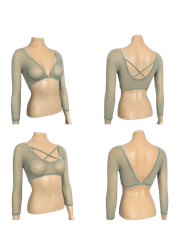
Sleeves vs. Cardigans, Layering Tops, and Tailoring Sleeves
9/ 29/ 2026
Summary
When a sleeveless dress needs more coverage, most people reach for the same three options without weighing them: a cardigan, a layering top, or having sleeves tailored onto the dress itself. None of those are wrong, exactly - but none of them were built specifically to solve bare-arm coverage either.
If you've been hunting for an alternative to a cardigan for a sleeveless dress, or you just want to cover your arms without a jacket changing the rest of the outfit, it helps to look at all four side by side before defaulting to whatever's already in the closet.
Why Is the Default Usually "Grab a Cardigan"?
A cardigan is the easy answer because it's already in the closet, not because it's the best fit for the job. It covers the whole torso, not just the arms, which means it also covers the neckline, the waistline, and any detail on the bodice you probably didn't intend to hide.
Cardigans add a second layer of fabric in the warmer months when you least want one, and they seldom match the rest of the outfit. A real alternative to a cardigan for a sleeveless dress has to be better than "I want to cover my arms" being synonymous with "I want to be warmer everywhere," because those are two different problems with two different solutions.
Side-by-Side Look: Sleeves vs. Cardigan
| Sleeves | Cardigan | |
| Coverage area | Upper arm to wrist/forearm only | Entire torso, shoulders, and arms |
| Effect on the dress | Dress stays fully visible | Neckline and bodice are covered |
| Added bulk | Minimal - thin, fitted fabric | Noticeable, especially layered over fitted dresses |
| Packing for travel | Folds flat, barely any space | Takes up real luggage space |
| Matching the outfit | Available in lace, mesh, and jersey to match dress fabric | Limited to whatever's in your closet |
It all comes down to one precision point: one covers exactly the area you want; the other covers a lot more than you want.
What About a Layering Top?
A layering top - a fitted tee, a mock-neck, a thin turtleneck - solves a slightly different problem than a cardigan. It works as a layering top for arm coverage if you also want more coverage at the chest or shoulders, but the neckline of the outfit changes, which is usually the opposite effect to what we want when we pick a dress for its neckline.
A layering top for arm coverage also needs to be fitted well to avoid bulk under the arms, and finding one in the right color and weight for every dress in rotation is its own kind of project - it's rarely a one-and-done purchase the way a single pair of sleeves can be.
Tailoring Sleeves Onto a Dress
Tailoring sleeves onto a dress is the most "finished" of the options, and it's a legitimate choice if you have one dress you know you'll wear for years - a mother-of-the-bride dress, for example.
But it comes with real trade-offs: it costs money and time with a seamstress, it can't be undone if you change your mind about the length or fabric, and it only solves the problem for that one dress. Tailoring sleeves onto a dress also locks the sleeve length and fabric in permanently, so there's no swapping lace for mesh depending on the weather or the event.
The Cold-Shoulder Look Without a Cardigan
One thing a cardigan, a layering top, and tailored sleeves all have in common: none of them give you that cold-shoulder, shoulder-baring silhouette that's been popular in dresses and tops for years now.
Slip-on arm sleeves are really the only option on this list built for the cold-shoulder look without a cardigan - they cover the arm while leaving the shoulder and neckline completely open, which is the whole point of a cold-shoulder silhouette in the first place.
A cardigan covering the shoulder defeats the style it's meant to complement, and a layering top does the same thing from the other direction - there's no version of the cold shoulder look without a cardigan if the cardigan is still covering the shoulder. If getting the cold shoulder look without a cardigan is the goal, sleeves are the only item on this list built for it intentionally.
Try Before You Decide
If slip-on sleeves are new to you, start with our size chart to get the fit right, then compare fabrics - lace sleeves for dressier occasions, jersey sleeves if you also want a bit more warmth, or mesh sleeves for something light enough for summer events. Any of these options work better as a layering top for arm coverage replacement than an actual top would, since none of them add bulk at the shoulder.
For more on choosing between fabrics, see Lace Sleeves vs. Mesh Sleeves: Which Style Is Right for Your Outfit?, or browse the complete range in View All Styles.
A cardigan, a layering top, and a tailored sleeve all cover arms in their own way, but none of them were built to do only that. If the goal is simply to cover your arms without a jacket - and without losing the dress underneath it - sleeves built for exactly that job are the simpler answer.
Frequently Asked Questions
What's the actual difference between a shrug, a bolero, and arm cover sleeves?
A shrug and a bolero are both cropped jackets that cover the shoulders and upper back as well as the arms - a shrug is typically the more casual, unstructured version, and a bolero the more tailored one. Arm cover sleeves don't touch the shoulder or back at all; they cover only the arm, which is why they don't compete with a cold-shoulder or strapless neckline the way a shrug or bolero can.
Is a bolero warmer than a cardigan?
No. A bolero is cropped and usually made from lighter fabric, so it adds some coverage at the shoulders but less overall warmth than a full cardigan. If warmth is the actual goal rather than arm coverage specifically, a cardigan - or a coat you check at the door - is still the better choice.
Can I check a coat or cardigan at the venue and still have arm coverage for photos?
Yes, and it's a common combination: wear a coat or wrap for the walk in and out, check it at the door, and keep slip-on sleeves underneath for coverage during the part of the event where photos happen. You get warmth for the parts that need it without the dress staying covered the whole night.
Does a bolero or shrug work over a strapless or cold-shoulder dress?
Not well. Both sit on the shoulder and upper back, which covers exactly the area a strapless or cold-shoulder neckline is designed to show. Arm cover sleeves are the one option on this list that leaves the shoulder line untouched.
Is a cardigan ever the better choice over arm sleeves?
Yes - when the goal is genuinely to be warmer everywhere, not just to cover your arms, or when the dress underneath isn't the focal point of the outfit. If the dress is the reason you got dressed up in the first place, sleeves keep it visible in a way a cardigan doesn't.
Can arm cover sleeves be worn under a blazer or jacket for a black-tie event?
Yes. For black-tie or very formal dress codes, a tailored jacket or wrap often provides the expected silhouette, and slip-on sleeves underneath handle arm coverage without changing the dress's neckline - useful if the jacket comes off for dinner or dancing and you still want coverage underneath it.
Will a tailored sleeve added by a seamstress match the dress fabric better than a separate sleeve?
It can, since a seamstress can cut the sleeve from leftover fabric or a closely matched bolt. A separate slip-on sleeve in a complementary lace or mesh gets close but won't be an exact fabric match - the tradeoff is a slightly less perfect match in exchange for being able to remove the sleeve and reuse it on a different dress later.